
The rules of chess fit on one page, but there is no need to give a child all of them at once. Below are all the rules in plain words, in the order that is easiest to teach. The first three sections are needed from day one; the rest can wait until your child moves the pieces with confidence.
The board and the pieces
A chessboard is a square of 64 squares, light and dark. Place it so that each player has a light square in the bottom right corner.
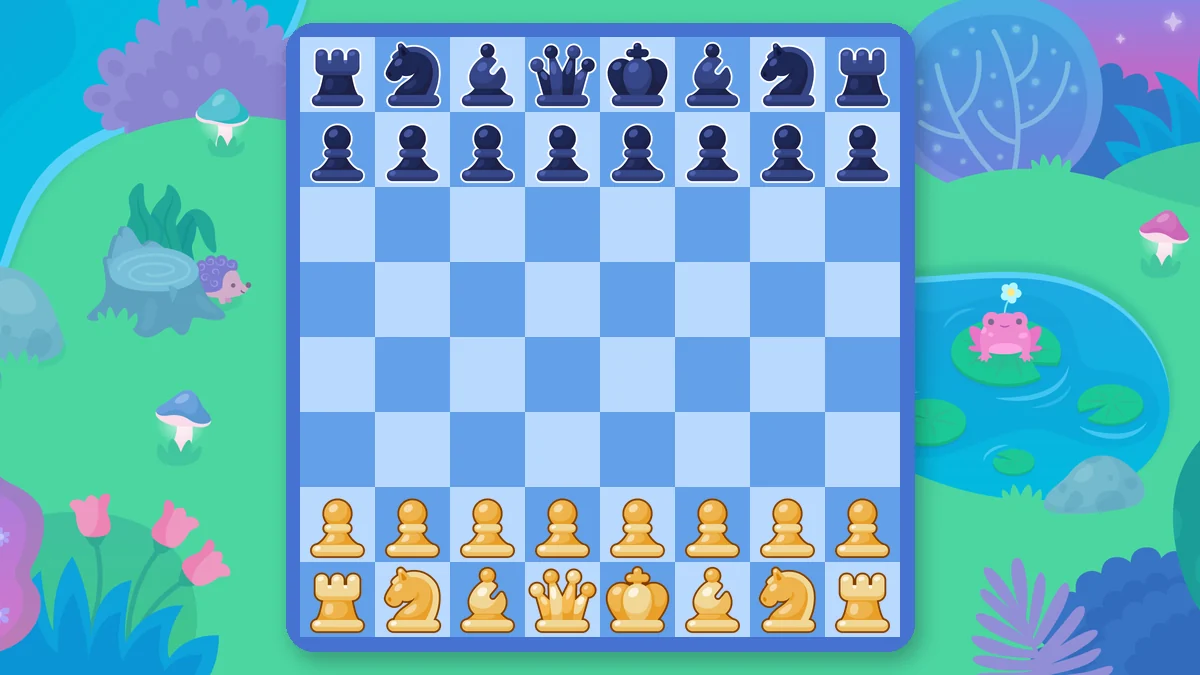
Each player has 16 pieces: a king, a queen, two rooks, two bishops, two knights and eight pawns. One player has white, the other black. White always moves first, then the players take turns.
Setting up: rooks go in the corners of the first row, knights next to them, then bishops. The queen goes on a square of her own color: white queen on a light square, black queen on a dark one. The king stands next to the queen. Pawns fill the second row.
A hint for your child: "The queen loves her own color."
How the pieces move
- Rook — in a straight line forward, back or sideways, as many squares as it likes.
- Bishop — diagonally, as many squares as it likes, always staying on its color.
- Queen — like a rook and a bishop together.
- King — one square in any direction.
- Knight — in an L-shape: two squares straight and one to the side. It is the only piece that can jump over others.
- Pawn — one square forward, or two on its very first move. It captures diagonally forward.
No piece except the knight can jump over other pieces. A game for teaching each piece is in How to Explain Chess Moves to a Child.
How pieces capture
If a piece can move to a square occupied by an opponent's piece, it takes that piece and stands in its place. You can't capture your own pieces. The pawn is the exception: it moves straight but captures diagonally.
Check, checkmate and stalemate
Check means the king is under attack. You may not leave your king in check: move the king away, block the attack with another piece, or capture the attacking piece.
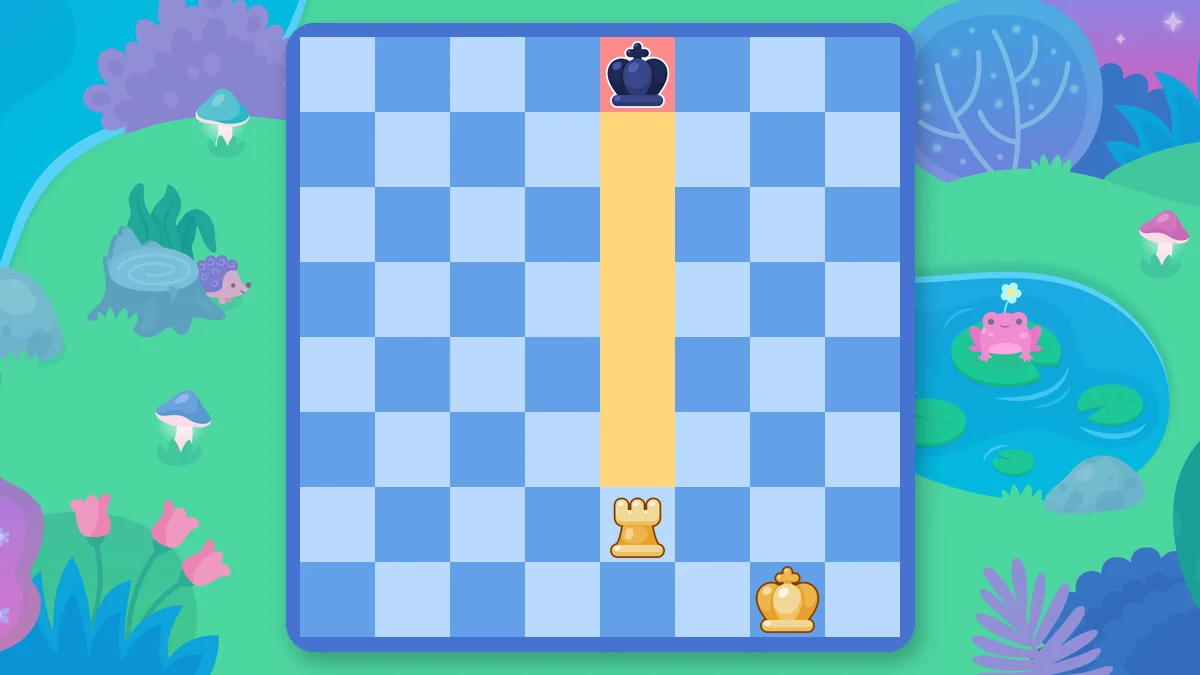
Checkmate is a check with no way out. Whoever gives checkmate wins. The king is never actually captured — the game ends first.
Stalemate means a player has no legal move, but their king is not in check. It is a draw. Show it with a simple example: a king in the corner, nowhere to go, and no check.
Teach check and how to escape it first. Checkmate and stalemate come next, once your child spots threats easily.
Special rules
Explain these three once your child is playing simple games.
Pawn promotion. When a pawn reaches the last row, it turns into any piece except a king — usually a queen.
Castling. Once per game the king and a rook can move together: the king steps two squares towards the rook, and the rook jumps over it to stand next to it. Not allowed if the king or that rook has already moved, if there are pieces between them, if the king is in check, or if it would pass through a square under attack.
En passant. If an opponent's pawn jumps two squares on its first move and lands next to your pawn, your pawn may capture it as if it had moved only one square. You can only do this on the very next move.
When it's a draw
- stalemate;
- neither side has enough pieces to checkmate, for example only the kings are left;
- the players agree to a draw;
- the same position appears three times;
- 50 moves in a row pass with no capture and no pawn move.
For children's games, the first two are enough.
This article retells the rules in plain words for teaching a child. The full official text is the FIDE Laws of Chess, which is what tournaments use.
The order to teach the rules
- The board and the moves — one piece per session.
- Capturing.
- Check and how to defend against it.
- Checkmate: first with a rook or queen against a lone king.
- Stalemate, promotion, castling, en passant.
A step-by-step plan from the first piece to the first game is in How to Teach a Child to Play Chess from Scratch.