
The first session decides whether a child wants to come back to the board. The goal is not to learn the rules — it is for your child to leave with "I did it!" and "what's next?". Below is a 20-minute script you can run at home with no preparation.
What you need
- A board and pieces. Any set will do; large pieces are better.
- 5–6 small prizes: sweets, counters, buttons.
- 20 minutes when your child isn't hungry, tired or in a hurry.
- Phones away — yours too.
Minutes 1–5: meet the board
Don't start with rules. Start with a story: "This is a kingdom. Two armies live here, white and black. Each one has a king, and the king must be protected."
Then a little exploring:
- count the squares in one row together — there are eight;
- find all the squares of one color in a row;
- let your child put a prize on any square and say whether it is light or dark.
That is enough for the board to feel familiar, not scary.
Minutes 5–12: the first piece — the rook
Start with the rook: it has the simplest move.
How to explain: "The rook is a tower on wheels. It only drives straight: forward, back, left, right. It can't turn while it's moving."
"Collect the sweets" game. On an empty board, one rook and 3 prizes. Your child collects them with the rook. Once that works, add more prizes or ask to collect them all in as few moves as possible.
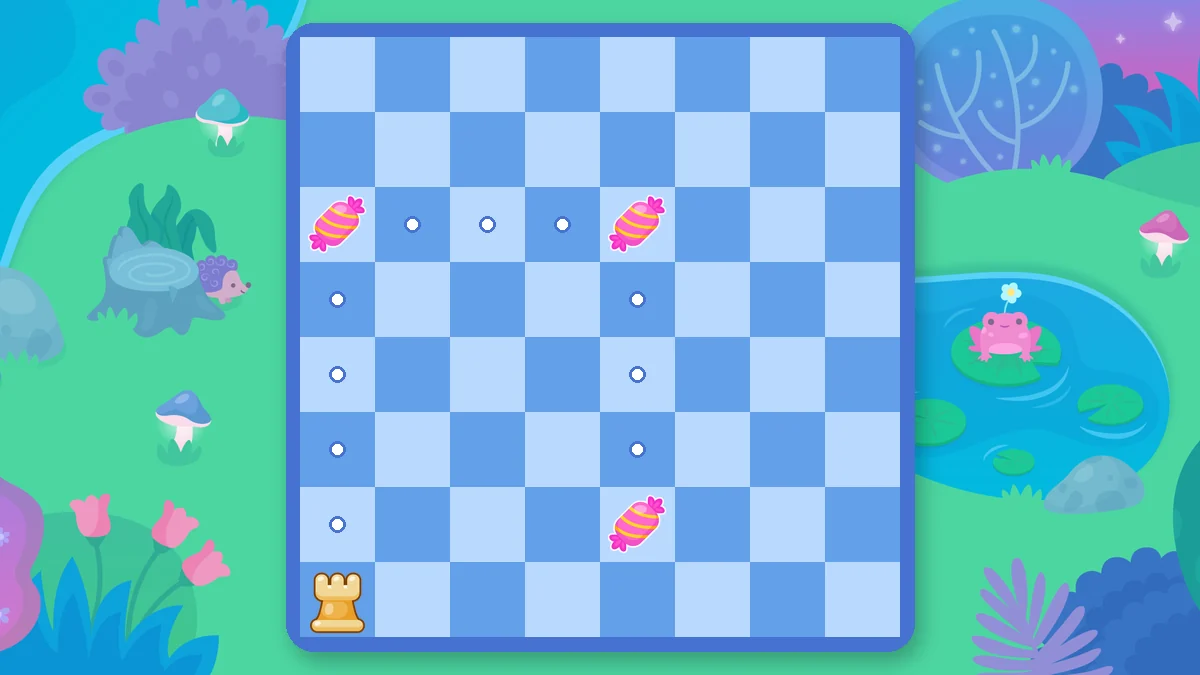
If your child moves the wrong way, don't correct right away. Ask: "Can the rook turn?" — and let them find the mistake.
Minutes 12–17: a little race
Play "Rook race": each of you has a rook, prizes are scattered on the board. Take turns; whoever collects more wins. Lose on purpose, quietly — on the first day, your child should win.
Minutes 17–20: how to finish
- Stop while it is still fun. Ending on a high note beats dragging on into boredom.
- Ask: "What can the rook do?" — let your child explain in their own words.
- Show the next piece without explaining it: "Next time we'll meet the bishop. It can do something the rook can't."
Common first-lesson mistakes
- Too many pieces. A preschooler won't remember all six at once. One piece per session.
- A full game straight away. A full game is 32 pieces and a dozen rules. Your child will lose and get bored.
- A long session. At 4–5, attention lasts 10–15 minutes; at 6–7, about 20–25.
- Correcting every move. Mistakes are part of the game. Ask questions instead of giving answers.
What comes next
Session two is the bishop, session three the queen as "rook and bishop together", then the king, knight and pawn. Games for each piece are in How to Explain Chess Moves to a Child. The whole path to the first game is in How to Teach a Child to Play Chess from Scratch.
In Fenomen, the first levels work just like this lesson: one piece, items on the board and a task to collect them — with voice prompts your child understands without reading.